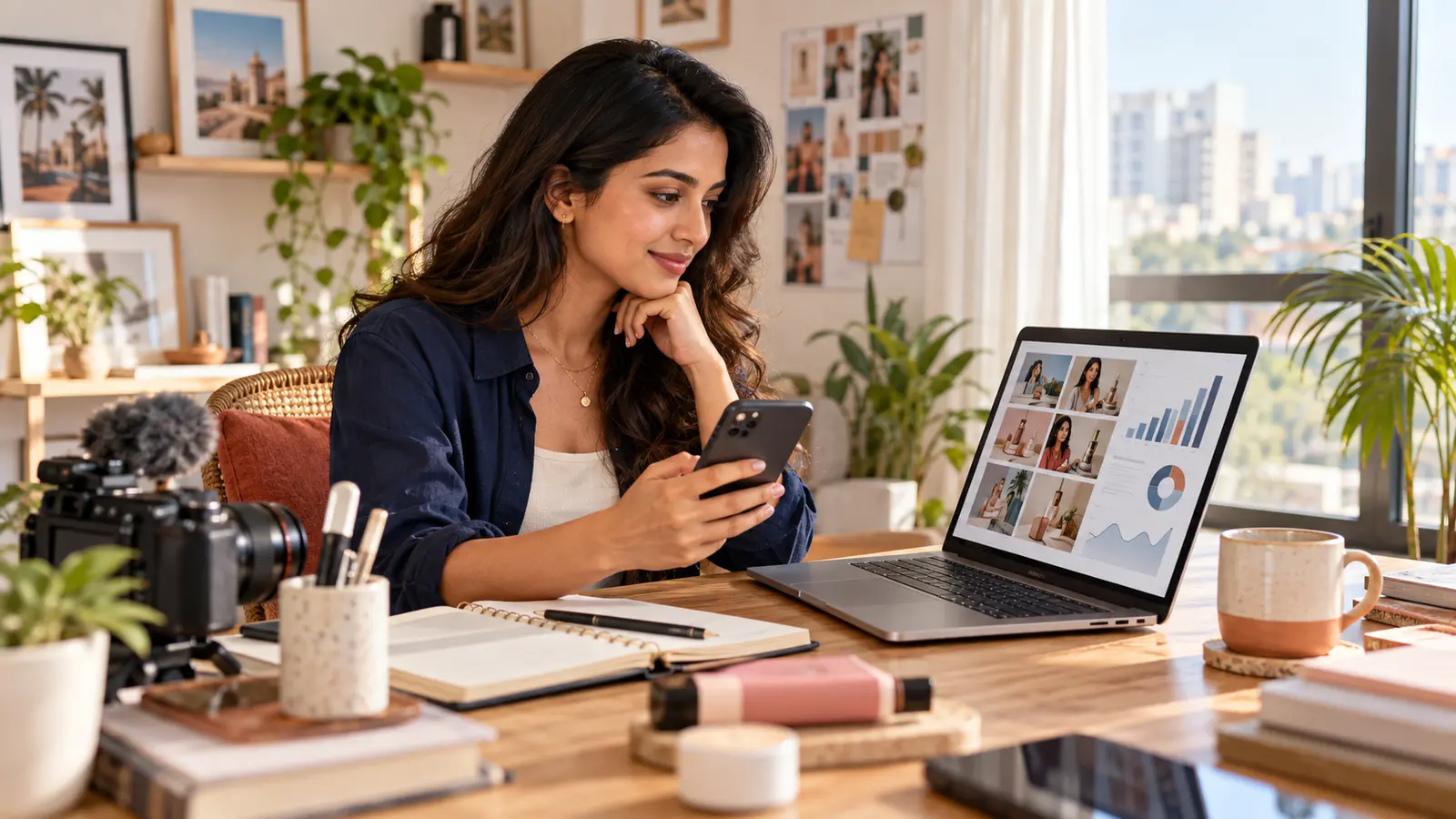
AI-generated editorial illustration of a fictional creator preparing partnership material.
YouTube is expanding the tools that connect creators and brands. In its India update published on 24 September 2026, the company said creators in India can use YouTube Creator Partnerships to be discovered by brands, while new Studio assistance for responding to briefs and building proactive pitches is coming soon.
That does not mean every channel will receive deals, and a pitch should never inflate reach or promise sales. It does mean Indian creators have a timely reason to organise their channel evidence, audience fit, content concept, price and usage terms before a real brief arrives.
YouTube's official India announcement says Creator Partnerships lets creators in India put their channels in front of brands. Once sponsored content is posted, a creator can generate a one-click access code so a brand can review video performance and, with permission, promote the content through Creator Partnerships Boost.
Planning Shorts content?
Estimate Shorts earnings by views, country and RPM.
YouTube also announced that Ask Studio will soon help creators respond to briefs, create proactive pitches and adapt a Media Kit to a brand's goals. “Soon” matters: do not assume those capabilities are already available in every account.
The same announcement says YouTube Shopping tags produced more than twice as many clicks as description links in a recent study. That is YouTube's study about shopping behaviour; it is not evidence that every tagged video will double its clicks or revenue.
A good brand pitch answers six questions
A brand manager should be able to understand the proposal quickly:
Who are you? Your niche, language and content format.
Who watches? Relevant audience facts supported by current analytics.
Why this brand? A genuine connection between the product and viewer need.
What will you make? A specific deliverable and creative idea.
What rights are included? Organic publication, editing, paid usage and duration.
What will it cost? A clear fee, tax treatment, payment schedule and validity period.
Subscriber count alone does not answer these questions. A smaller Tamil gadget channel may be more relevant to a regional electronics launch than a larger general-entertainment page.
Step 1: define the audience fit
Write one evidence-backed paragraph. Use only metrics you can see in your current YouTube Analytics or another authorised source.
Example:
I publish practical smartphone-editing tutorials in Tamil and English for early-career creators. During the last 90 days, most viewers came from India, and my strongest videos answered mobile editing and captioning questions. I am proposing a short demonstration for viewers choosing an affordable microphone for phone-based production.
Replace the general statements with your actual dates and numbers where useful. Do not claim that viewers have a particular income, profession or purchase intent unless your data genuinely supports it.
Step 2: translate the rough thought without losing meaning
If you think naturally in Hinglish, draft the idea in your own words and use the Hinglish to English Translator to create a formal English version.
For example, the rough note might be:
Mere audience ko mobile se clean audio record karne mein problem hoti hai. Main real room mein before-after test dikha sakta hoon.
A useful edited version is:
My audience often struggles to record clean audio on a phone. I propose a practical before-and-after microphone test in a real room.
Review product names, numbers and commitments after translation. The tool sends text to an online AI provider and has a 5,000-character request limit, so do not paste confidential briefs, passwords, unreleased campaign details or personal information you are not authorised to share.
Step 3: turn the fit into a concrete content concept
Avoid vague promises such as “I will make a viral Reel”. Describe the viewer problem, demonstration and deliverable.
Weak concept:
I will promote your microphone in an engaging video.
Stronger concept:
A 45-second Short will compare phone audio before and after connecting the microphone in the same untreated room. The first five seconds will demonstrate the difference. I will explain connection, placement and one limitation, then disclose the paid partnership clearly.
You can use the Viral Reel Script AI to create a first hook, body and scene guide. Treat “viral” as the tool's product name, not a promised result. Rewrite the output so the claims match the product evidence and your own voice.
Step 4: specify the deliverables
List exactly what the fee covers. For example:
| Item | Example scope |
|---|---|
| Main deliverable | One 45–60 second YouTube Short |
| Language | Tamil voice with reviewed English subtitles |
| Revision | One factual correction round before publication |
| Publication | Remains public on the creator's channel for six months |
| Raw files | Not included |
| Paid usage | Not included unless separately agreed |
| Deadline | Draft within seven working days after product receipt |
These are examples, not default industry terms. Change them to the agreement you can actually fulfil.
Separate production from licensing. A brand asking to edit, repost or run your video as advertising is requesting additional rights. State the territory, platforms, duration, editing permission and whether the brand can use your name, face or voice.
Step 5: quote the work clearly
Use the Desi Invoice Maker to prepare a quote after the scope is agreed. Include:
creator or business name and contact details;
client name and billing details;
itemised deliverables;
fee, applicable tax and total;
quote validity;
payment milestones and due date;
revision limit;
licensing or paid-usage fee; and
cancellation or rescheduling terms.
The tool can generate a PDF and can include a UPI QR, but it is not accounting or legal advice. Review GST, TDS, invoice numbering and record-keeping requirements with a qualified professional for your situation. Never use a payment QR to replace a written agreement about the scope.
Step 6: respond to the brief line by line
A tailored response is more useful than a generic media-kit attachment. Use this structure:
Opening
Name the campaign and explain the audience connection in two sentences.
Proposed idea
Describe the opening visual, product demonstration and viewer takeaway.
Deliverables
State format, length, language, platform, number of revisions and delivery date.
Evidence
Provide relevant channel metrics with the date range and links to two or three comparable videos. Do not cherry-pick unrelated viral posts.
Commercial terms
Give the fee and separate optional charges for exclusivity, extended usage, whitelisting/boosting, raw files or additional edits.
Next step
Ask the brand to confirm the final brief, mandatory claims, prohibited claims, disclosure requirements, product delivery and approval contact.
Understand brand partner access before sharing it
YouTube's current help page explains that a creator can generate a unique link for a sponsored video. When accepted, the video connects to the brand's Google Ads account.
The page says sharing access can disclose non-public video-level metrics, including watch time, average view duration, engagement and audience geography, and can allow the brand to promote the video through Creator Partnerships Boost. Review what is shared before accepting or sending access. YouTube also provides a way to remove access later, but that does not replace a clear contract about usage.
Do not forward an access link from an unexpected email without checking the request inside YouTube Studio. Confirm the brand, agency, campaign and Google Ads relationship through known contacts.
Disclose paid or gifted relationships
YouTube's brand-deal guidance says free products or services provided in exchange for content can create disclosure obligations. Use YouTube's paid-promotion setting when applicable and make the disclosure clear to viewers.
Hello [name], I create [format] in [language] for [audience]. My recent [relevant topic] content shows that viewers regularly ask about [problem].
I propose [one-sentence concept]. The deliverable would be [format, length and platform], with [revision and timeline]. The video will include an appropriate paid-partnership disclosure.
Relevant channel evidence: [dated metrics and two links]. My fee for the stated scope is [amount and tax treatment]. Paid media, extended usage, exclusivity and raw files are not included unless agreed separately.
If this fits the campaign, please share the final brief, required claims, usage period, approval process and payment terms.
Personalise every bracket. Do not send the same mass pitch to unrelated brands.
Frequently asked questions
Is YouTube Creator Partnerships available in India?
YouTube's 24 September 2026 India announcement says creators in India can use Creator Partnerships to get their channels in front of brands. Eligibility and individual features may vary, so check the current YouTube Studio experience and official criteria.
Is Ask Studio already writing brand pitches for everyone?
No. YouTube described brief responses, proactive pitches and Media Kit advice as features coming soon. Availability can differ by account and rollout stage.
Does sharing brand partner access reveal private analytics?
It can share specified non-public video-level metrics with the connected brand and allow promotion through Creator Partnerships Boost. Review YouTube's current help page and the request inside Studio before consenting.
What should a creator charge?
There is no single correct price. Consider production time, audience fit, revisions, exclusivity, licensing duration, paid usage, raw files, taxes and payment risk. Do not copy another creator's rate without comparing scope.
Can AI write the whole pitch?
AI can help structure or translate a draft, but you must verify analytics, claims, deliverables, price, confidential information and legal terms. A generic fluent pitch is less valuable than a short proposal based on real audience fit.
Does a professional pitch guarantee a deal?
No. It makes the offer easier to evaluate. Brand budget, campaign timing, audience fit, eligibility and negotiation still determine the outcome.
The opportunity in YouTube's update is not a shortcut to sponsorship. It is a reason to treat creator work like a clear business proposal: specific audience, honest evidence, useful concept, defined rights and a quote both sides can understand.