YouTube Video A/B Testing: Prepare Three Opening Cuts Before It Arrives
YouTube video A/B testing is coming soon. Learn how to prepare three distinct opening cuts, control variables and avoid false conclusions before access arrives.
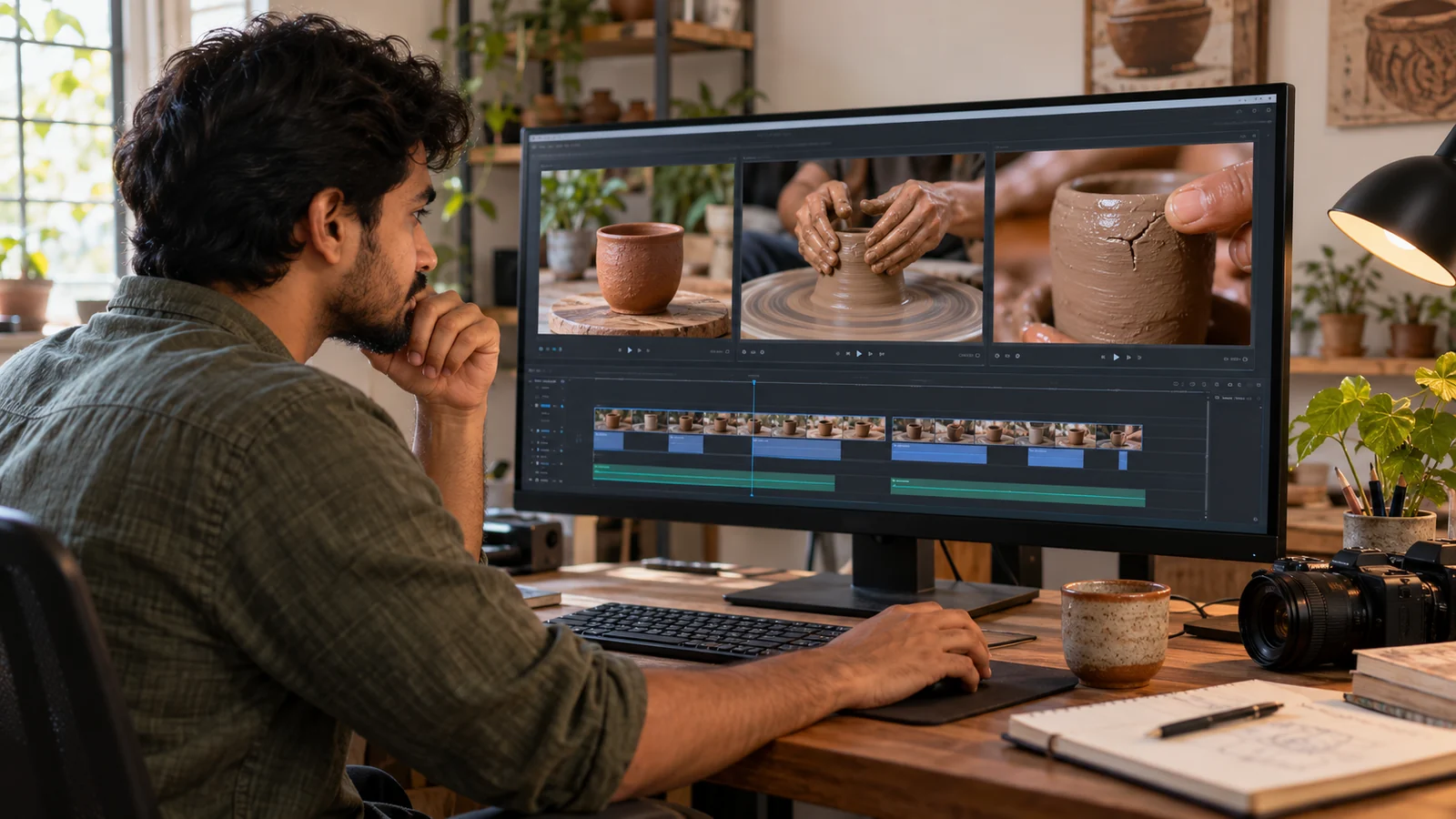
AI-generated editorial illustration. It represents an editing workflow; it is not a screenshot of YouTube Studio or evidence of feature access.
YouTube has announced a new video A/B testing feature that will let creators compare up to three cuts of a video to see which hook holds attention best. The important availability detail is easy to miss: YouTube described the feature as “coming soon” on 23 September 2026. It is not the same as the title-and-thumbnail A/B testing tool that is already documented in YouTube Help.
That makes this a preparation guide, not a claim that every channel can use the new control today. The useful work you can do now is design three opening cuts that test a clear creative question without changing the whole video.
What YouTube has actually announced
In its official Made on YouTube creator update, YouTube said the future tool will let creators test up to three video cuts to find which hook performs best. A separate YouTube announcement described the comparison as finding which cut holds audience attention best.
YouTube has not yet published a complete help page for video-cut testing with eligibility rules, rollout countries, exact reporting screens or a universal launch date. If the control is not visible in your Studio, do not assume your account is broken and do not follow unofficial instructions that claim to unlock it.
The existing title-and-thumbnail test is different. That current desktop Studio tool can compare up to three titles, thumbnails or combinations on eligible long-form videos, and it chooses results using watch time. Its current restrictions include no Shorts, scheduled live streams, Premieres before they become ordinary long-form videos, Made for Kids videos, private videos or mature-audience videos.
The editing problem: change the hook, not the promise
A useful test needs variants that are different enough to teach you something but similar enough to answer one question. If Cut A is a careful tutorial and Cut B becomes a comedy montage with different music, length and topic, you will not know which change affected the result.
Keep these elements constant:
the core topic and viewer promise;
the main body after the opening;
the audio loudness and basic image quality;
essential context and disclosures;
the title and thumbnail while testing the video cut, unless YouTube’s eventual workflow explicitly combines variables.
Change one opening idea at a time.
A three-cut framework you can prepare now
Use one master timeline, duplicate it twice, and label the sequences clearly: A-result, B-action, and C-problem.
Cut A: show the result first
Open with the finished outcome, then explain what the viewer will learn.
Pottery tutorial example: Show the finished clay cup in the first shot. Say: “This cup started as a wobbly cylinder. Here are the three hand positions that fixed it.”
This cut tests whether a clear payoff earns attention.
Cut B: begin inside the action
Start at the most visually legible movement instead of giving an introduction.
Example: Open on hands centring the clay while the wheel is moving. Add one line of context: “If the clay keeps pulling to one side, check this thumb position.”
This cut tests whether immediate motion is stronger than a result reveal.
Cut C: name the specific problem
Lead with the mistake the intended viewer already recognises.
Example: Show a cracked rim and say: “If your cup splits here, the problem probably started 20 seconds earlier.”
This cut tests problem recognition and curiosity.
These are editorial suggestions, not guaranteed winners. A strong option for one channel may be weak for another because audience expectations, traffic sources and topic familiarity differ.
Each opening should join the same master body at the same narrative point. Write down the exact difference between versions in a small test note. That prevents accidental changes such as a different music bed or a longer explanation in only one cut.
How to make the three hooks meaningfully different
Before exporting, ask four questions:
Can a muted viewer understand the first shot? Many viewers encounter video previews without immediately hearing the audio.
Does the opening deliver the same promise as the title and thumbnail? A dramatic hook that misrepresents the video may attract the wrong viewer.
Is the difference visible within the opening itself? Moving the same sentence by half a second is unlikely to teach you much.
Does each version reach the shared body cleanly? Avoid awkward repetitions when the alternative opening joins the master edit.
For multilingual channels, keep the visual idea understandable across languages. If you use Hindi, Hinglish or English voice-over, add accurate captions rather than assuming every viewer understands the same language.
What you can check with KuchhBhi today
KuchhBhi does not run YouTube’s video experiment or predict retention. You can use the Thumbnail Text Previewer separately to check whether your title-card artwork remains readable at a small size. It exports landscape or portrait PNGs, but it does not calculate contrast, simulate the exact YouTube interface or predict click-through rate.
Treat packaging and the opening cut as separate decisions. A readable thumbnail can set the correct expectation; the first seconds must then deliver on it.
When the feature appears in your Studio
Follow the controls and eligibility notes shown in your own account. Before starting:
keep the three source exports archived;
record which opening idea each file represents;
check that captions, disclosures and audio are equivalent;
avoid changing several variables during the test;
let the platform’s stated test period finish unless there is a factual or safety reason to stop.
Do not report an early lead as a final result. YouTube’s current title-and-thumbnail documentation says tests may take a few days or up to two weeks and can end without a clear winner. The future video-cut test may use different rules, so rely on its own help documentation once YouTube publishes it.
Limitations to understand
The video-cut feature was announced as coming soon; access may not yet be available.
YouTube has not published complete public instructions for its rollout at the time of this article.
Three variants cannot isolate a cause if several creative elements change at once.
Small channels or narrow topics may not generate enough comparable viewing for a decisive result.
A result from one video does not prove the same opening will work for every topic.
KuchhBhi cannot start, read or verify a YouTube Studio experiment.
Frequently asked questions
Can I use YouTube video A/B testing now?
YouTube announced the feature on 23 September 2026 and called it “coming soon.” Availability may vary. Check your own YouTube Studio and official Help pages instead of assuming universal access.
Is this the same as testing titles and thumbnails?
No. Title-and-thumbnail A/B testing is already documented. The newly announced video test compares up to three cuts to evaluate hooks.
Should all three cuts have different titles and thumbnails?
Not if your goal is to learn about the opening cut. Keep other variables stable unless the future YouTube workflow specifically instructs you to test them together.
Can I test Shorts?
YouTube’s current title-and-thumbnail A/B test does not support Shorts. The September announcement did not provide full public eligibility rules for video-cut testing, so wait for the dedicated official instructions.
Does the shortest opening always win?
No. The useful opening is the one that makes the right promise clearly and earns continued attention. Brevity can help, but clarity and expectation-matching matter more than an arbitrary number of seconds.
Can KuchhBhi tell me which cut will perform best?
No. KuchhBhi’s preview tool can help you inspect thumbnail readability. Only a real platform test with your audience can compare performance, and even that may be inconclusive.
Fact check completed 11 October 2026. This article distinguishes YouTube’s announced video-cut test from the title-and-thumbnail test that currently has a public Help page.